
Begin East Carbon's Check with the Court on the Paper
The East Carbon city website gives you a municipal contact and little else. It offers no warrant lookup of its own. So read the case paper before you call anything. A citation, summons, or notice names the court that matters. If the court is unclear, city hall can help route a local government question, but only a court clerk can confirm whether a judicial order stands or has been recalled.
- Find the issuing court and case number on the paper you received.
- Contact East Carbon City Hall for local office routing, not a warrant decision.
- Call the court named in the case to confirm the docket and current order.
- Use CountySuite or Utah BCI SWW only as additional name-search context.
- Ask the issuing court for the exact next step and keep its instructions.
East Carbon City Hall Is the Published Local Contact
East Carbon City Hall sits at 101 W Geneva Dr, and its listed phone is (435) 888-6613. Posted weekday hours run 9 a.m. to 6 p.m., with a lunch closure from noon to 1 p.m. The East Carbon contact page is a fair starting point for a municipal routing question, though it names no warrant clerk and offers no online warrant search. Before calling or visiting, decide what you actually need: a city service, a police record, or a court case. Say which, and staff can send the request where it belongs.
This public listing supports city contact routing; it does not certify warrant status.
East Carbon Police and Court Details Are Not a Single Online Record
East Carbon publishes no single online record that ties police, court, and warrant details together. The city posts no police warrant list and runs no municipal-court warrant portal. Utah's court calendar does list East Carbon Justice Court, but the city has no separate court website with a local warrant search. That gap means direct confirmation: call the court named on the case, and use city hall's published route when you need a local number. The gap does not mean the city lacks a court process. Avoid old phone numbers, and never assume another Carbon County city's court contact covers East Carbon.
East Carbon's Municipal History Helps Identify Old City References
Old paperwork in East Carbon can carry names that no longer match the map. The city incorporated in 1973 from the communities of Dragerton and Columbia, and Sunnyside merged in on January 1, 2014. Those dates matter when a record, address, or citation bears a legacy community name. The name alone cannot tell you which office holds the case now. East Carbon's city page explains the incorporation and Sunnyside merger history alongside its municipal information. For an older citation, keep the original court and case number, then ask the clerk whether the case stayed in that office or moved.
East Carbon's history page explains the city's name and boundaries, nothing more. It cannot tell you the status of any warrant.
Warrant Actions That May Arise in an East Carbon Case
Warrant types follow the legal matter and the court, not the city's contact page. A failure to appear can trigger judicial action under the applicable rule, but check a missed date or unpaid citation against the actual docket before assuming anything. Arrest warrants take a separate probable-cause path. In every East Carbon case, the issuing court controls what happens next.
| Case clue | Possible warrant route | What to confirm |
|---|---|---|
| Traffic or citation paperwork | Possible bench-warrant action after a required appearance | Court named on the citation and current date |
| City ordinance matter | Judicial order in a filed municipal case | Whether East Carbon Justice Court holds the case |
| Bench warrant | Judge's order connected with a court matter | Active status and instructions from the clerk |
| Arrest warrant | Separate probable-cause application | Issuing court or magistrate |
Plan Around East Carbon's Posted City Hall Hours
City Hall posts weekday hours of 9 a.m. to 6 p.m., closing for lunch between noon and 1 p.m. Those are city-office hours. No police desk or court-clerk schedule is published for East Carbon, so treat them as a municipal window, not a court one. If a hearing or deadline is close, use the court's own contact route instead of a city counter. When you call, ask which public office holds the record you need and get its current published number. If staff cannot answer a case-status question, ask for the court contact that handles the file. The city runs no dedicated warrant counter, no warrant-specific surrender protocol, and no special payment window that it publishes.
Office hours are not court orders: confirm any deadline, appearance, or warrant instruction with the named court.
What to Compare in an East Carbon Case File
East Carbon publishes no public warrant-result schema, so a search hit or a blank tells you little on its own. The court's docket may hold details a statewide name search never shows, and a search result can be stale, missing a later court action. A blank result does not prove no warrant exists. Work from the case document, and ask the issuing court to verify its current record.
| Name | Compare it with the person and case papers; similar names can appear. |
|---|---|
| Case number | Use the number printed by the issuing court; no city format was verified. |
| Court | Confirm the current court of record, including any transfer. |
| Charge or claim | Read the present docket entry rather than relying on an old summary. |
| Order status | Ask whether it is active, recalled, or otherwise changed. |
| Next action | Confirm any date, payment instruction, or appearance requirement. |
East Carbon's Census Figure Is Local Context, Not Case Data
East Carbon counted 1,556 residents in the 2020 Census. The figure sketches the city's size and nothing else. It says nothing about filings, outstanding orders, or how fast a clerk can answer a request, because population data and court records come from different places and serve different purposes. When a record uses an old community name, the city's history can explain the reference, but it still cannot replace the court and case number. The city page also links to census geography materials, which describe boundaries rather than any warrant records. The Census TIGERweb 2020 table is the population reference for incorporated places.
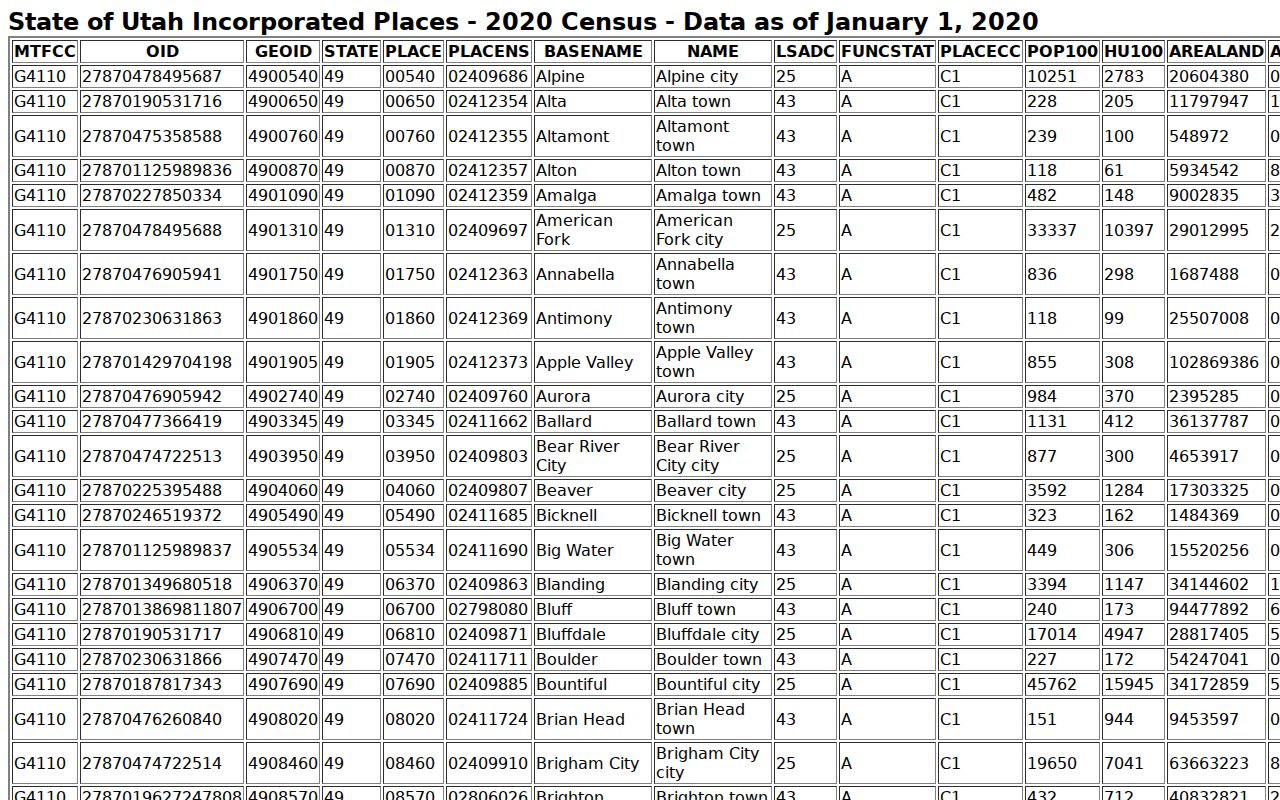
The census table supplies demographic context only; it is not a court search.
East Carbon's Place in County and State Searches
Start with the East Carbon contact route for local municipal questions, then use the court named on the case. CountySuite or Utah BCI SWW can add broader name-search context, but neither determines whether an East Carbon court order remains active. East Carbon municipal contact › Carbon County Sheriff/Jail for custody routing › Utah BCI SWW for statewide context.
For a wider lens, see the Carbon County warrant records overview and the county search page on countywide records and their limits. Whatever those searches show, East Carbon cases answer to the issuing court alone.
Use the Court Calendar as a Hearing List
The East Carbon Justice Court shows up on the Utah Courts calendar, but that tool tracks scheduled hearings, not warrants. A calendar entry is not a warrant roster. It can miss an order, a change, or a recall. The state updates the calendar every weekday at 5:30 a.m. Warrant changes can lag behind. A blank calendar search proves nothing about a recall. It cannot confirm that no appearance is required. If an East Carbon case appears, call the court with the case number and ask about the warrant directly. Utah Courts' public calendar describes the statewide hearing-list tool and how to use it.
Public Access Boundaries for East Carbon Court Documents
Access to East Carbon court files depends on the record holder and the court rules that govern it. GRAMA covers government records. Case files follow judicial procedure instead. Sealed, juvenile, and protected materials stay restricted, and asking for a copy never asks a judge to recall a warrant or excuse a missed court date.
Key Rules:
Utah GRAMA, Code §63G-2-201 covers public access to government records subject to statutory exceptions.
Utah Rule 4B governs citation procedure and possible bench-warrant action.
Utah Rule 40 allows some search-warrant materials to be sealed.
Ask for Court Records Through the Judicial System
East Carbon has no standalone warrant portal. So take a warrant or case-record question to the court named on the case, or use the request route Utah Courts publishes. City hall can help route a municipal inquiry. It cannot replace the court's record desk. When you write, describe the record and include the case number if you have one. Staff can say what public files can be copied. They can also explain any access limits. A GRAMA request to a municipal or county office reaches only records that office holds; it will not turn a court case into a city file. Utah Courts explains how to request a court record through its published process.